

From the dawn of competition, sports fans have always had a soft spot for the ultimate underdog story. There’s nothing quite like watching a team that nobody gave a chance pull off the impossible and shock the world.
One of the most electric examples in recent memory came in Week 6 of the 2021 college football season, when Vanderbilt—listed as a staggering 23.5-point underdog—stunned No. 1 Alabama with a historic upset. The Commodores delivered one of the biggest shocks in SEC history, and when the clock hit zero, delirious Vandy fans stormed the field at FirstBank Stadium, tearing down the goalposts in a scene of pure pandemonium. It was the kind of moment that reminds you why we love this game.
What happens if the team no longer becomes an underdog?
In 2019, Patrick Mahomes hoisted the Lombardi Trophy after the Chiefs beat the 49ers 31-20, ending a 50-year Super Bowl drought for Kansas City. Back then, the entire NFL world was rooting for Andy Reid to get his ring and for the electric young Mahomes to start a legendary career.
Fast-forward just five years: three Super Bowls, five straight AFC titles, and suddenly the same fanbase that once cheered for the plucky Chiefs now groans, “Here we go again.”
The underdog became the dynasty—and half the country is tired of it.
What happened?
Fans got tired of the Chiefs winning. Conventional sports fans love the uncertainty—who’s going to win? Any team could pull it off. But it became routine to expect the Chiefs in the AFC Championship, and watching the NFL lost its fun when you knew the outcome.
Fan culture also bred the idea they’re cheaters, with the NFL “script” rigged by refs. Look at the 2024 season: several one-score wins came on last-minute calls that swung it their way.
It started in the 2023 Super Bowl with the holding call on Eagles’ James Bradberry against JuJu Smith-Schuster on a key third down. It gave the Chiefs a first down, let them run out the clock, and kick the game-winning field goal. Yes, it decided the game, but a hold is a hold—the moment shouldn’t change how refs call it.
All in all, the Chiefs’ image is that refs always bail them out. Mahomes gets those late pass interference calls. The fan theory? Goodell scripts them to win every year.
What people do not realize
If you’re pointing fingers for favoritism, look at the Buffalo Bills. Two major NFL rule changes stemmed directly from Chiefs-Bills playoff clashes.
- Overtime rules (2022): Owners tweaked playoff OT so both teams get a possession unless the first scores a TD. It came after the 2021 AFC Divisional Round, where the Bills lost 42-36 without touching the ball in OT.
- Hawk Eye technology for line-to-gain measurements: The NFL rolled out camera tech to pinpoint if the ball crossed the marker. It was sparked by the 2024 AFC Championship, when Josh Allen’s QB sneak on 4th-and-inches looked good but replay was inconclusive, ruling him short.
I’m not knocking the changes—they’re needed. But not everything’s as it seems. If the NFL favors anyone, it ain’t the Chiefs.
If you go back to February 3, 2002…
Flip on the TV for Super Bowl XXXVI and you’ve got the “Greatest Show on Turf” Rams chasing their second title in three years against the New England Patriots.
For the Patriots, the story started when Drew Bledsoe—fresh off a 10-year, $103 million deal—took a brutal hit from Jets linebacker Mo Lewis in Week 2. The shot caused internal bleeding, thrusting second-year backup Tom Brady into the starting role.
New England scraped together wins all season with a grind-it-out run game and a suffocating defense. They survived the infamous snow-filled “Tuck Rule” game in the Divisional Round, where Adam Vinatieri’s overtime kick beat the Raiders 16-13. Then, in the AFC Championship against Pittsburgh, Brady briefly went down injured—only for Bledsoe to come off the bench and lead one final drive to seal the win. Sheer will carried the Patriots to New Orleans.

On the Rams’ side, an eerily similar quarterback tale unfolded. Back in February 1999, St. Louis signed Trent Green to a four-year, $17.5 million deal. In the 1999 preseason against San Diego, Green blew out his knee—tearing both ACL and MCL. At the post-game press conference, head coach Dick Vermeil famously declared…
“We will rally around Kurt Warner and play good football”.
They did exactly that—finished 13-3 and beat the Titans 23-16 in Super Bowl XXXIV.
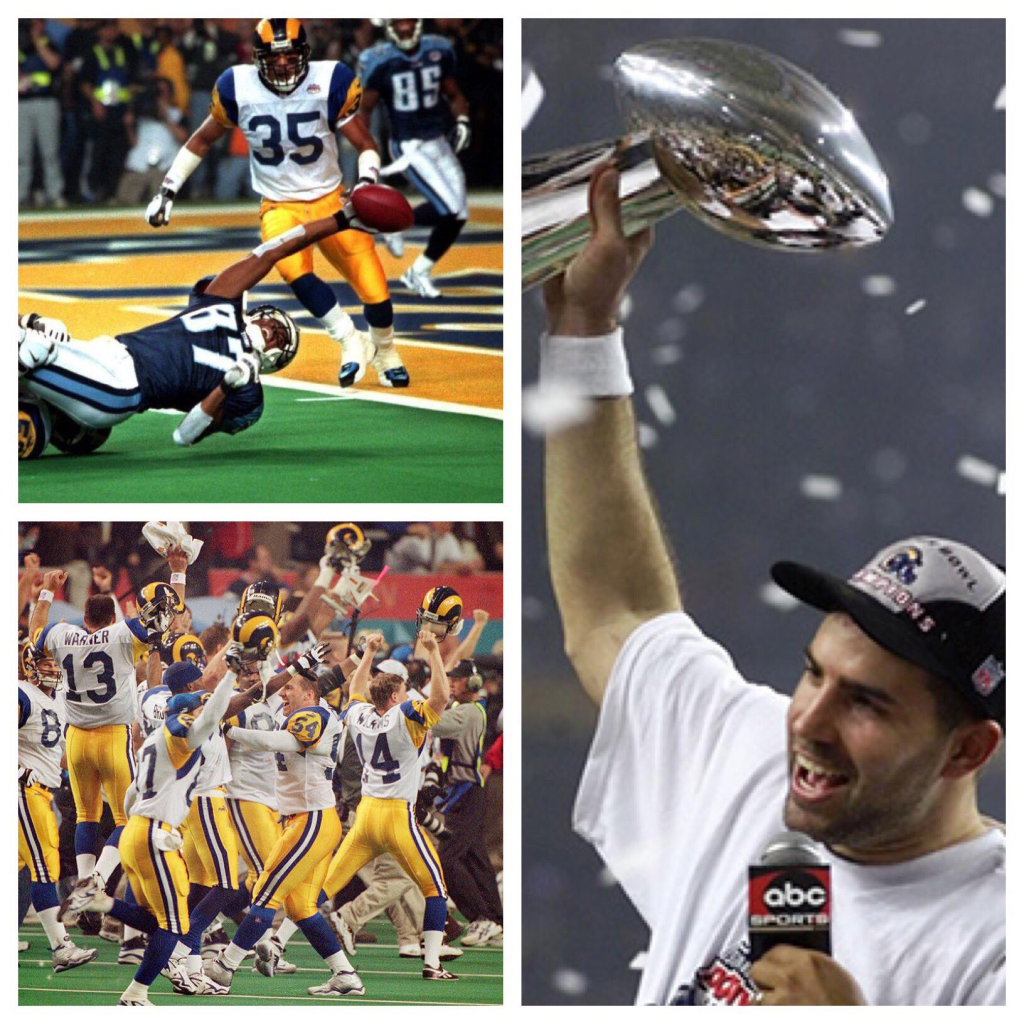
Fast-forward two years: the underdog Patriots, led by second-year QB Tom Brady, faced the explosive “Greatest Show on Turf” Rams in Super Bowl XXXVI. Bill Belichick’s defense kept St. Louis out of the end zone all night, and Brady’s ice-cold two-minute drive set up Adam Vinatieri’s game-winning kick as time expired.
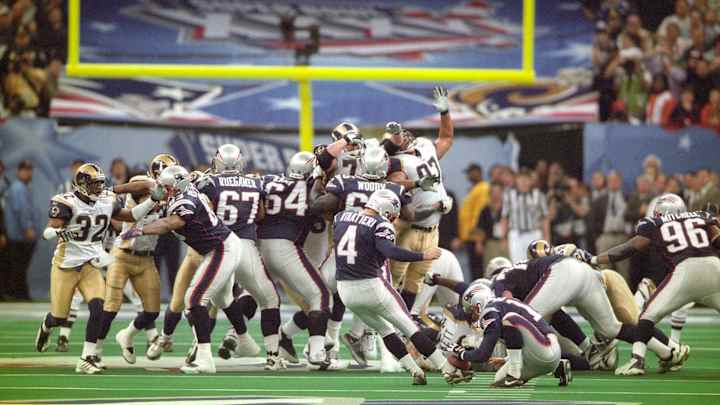
That victory in New Orleans kicked off an 18-year dynasty. With Belichick and Brady, the Patriots went on to:
- Won 5 more Super Bowls
- Appeared on 9 more Super Bowls
- Won 17 Division Titles
- Post the only 16-0 regular season in the modern era (the ’72 Dolphins remain the only team to go undefeated including playoffs)
So why the Patriots hate?
All that winning came with baggage—two scandals many believe gave them an edge:
- Spygate (2007): They got caught illegally videotaping the Jets sidelines during week 1 of the regular season
- Deflategate (2014): Footballs were purposely underinflated in the 2014 AFC Championship game against the Colts. According to the “Wells Report” it was conculcated that Brady was “generally” aware of what was happening.
Because of those stains, outside Massachusetts the Patriots became the team everyone loves to hate.
Are all dynasties supposed to be hated?
Do fans just get sick of seeing the same team win over and over?
Yeah, most do. People tune in for the chaos, for the chance that a 20-point underdog can shock the world on any given Sunday. When one team dominates, the uncertainty vanishes—and with it, most of the excitement.
 1821 Sports
Leave a comment